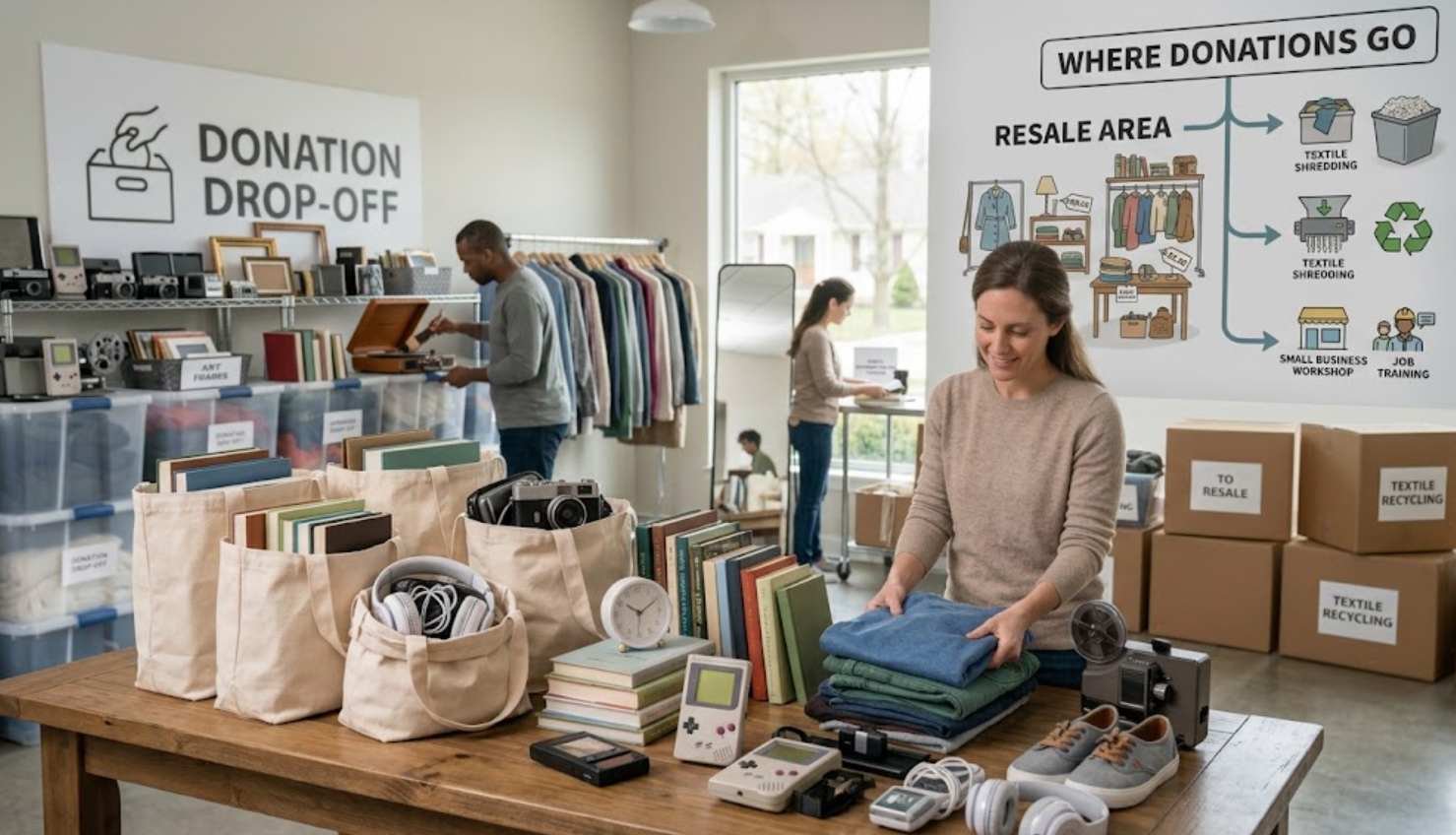
You hand over a bag of clothes, a box of books, or some household items at a donation center. But what happens to items donated to Goodwill after you leave?
They do not simply go straight onto a store shelf.
Donations usually pass through several stages. Items are received, inspected, sorted, priced, and prepared for resale when appropriate. Goods that do not sell may get another chance through outlet stores, salvage channels, or recycling programs.
Here is a practical look at the journey your donation may take.
Quick Guide: The Journey of a Goodwill Donation
Donation Drop-Off
↓
Initial Inspection
↓
Sorting by Item Type and Condition
↓
Pricing and Store Placement
↓
Sold to a Shopper?
Yes → Item gets a new owner
No → Outlet, salvage, reuse, or recycling may follow
The exact process can vary because local Goodwill organizations operate their own stores and donation programs.
Step 1: Your Items Arrive at a Donation Center
The process starts when you bring your belongings to an approved donation location.
An employee may receive the bags, boxes, clothing, electronics, books, or household goods and move them into a processing area.
If you have never donated before, understanding how Goodwill donation works can make your first visit much easier.
It also helps to organize your belongings before leaving home. Clean items, secure breakable objects, empty pockets, and keep sets together where possible. This simple guide to preparing items for a Goodwill donation can help you avoid common donation mistakes.
Are All Donated Items Accepted?
Not necessarily.
Acceptance policies can differ between locations. Certain damaged, hazardous, recalled, heavily soiled, or otherwise unsuitable products may not be accepted or sold.
That is why donors should check the rules of their local organization rather than assuming every household item can be donated.
Step 2: Donations Are Sorted and Inspected
Behind the scenes, workers separate donations into categories.
For example:
- Clothing
- Shoes and accessories
- Books
- Kitchenware
- Home décor
- Small appliances
- Electronics
- Toys
- Furniture, where accepted
Employees may also look at an item’s condition and whether it is suitable for resale.
A clean jacket in usable condition may move forward to the sales floor. A severely damaged or contaminated item may not.
This inspection matters because Goodwill stores need merchandise that shoppers can reasonably reuse.
Step 3: Sellable Items Are Priced
Items considered suitable for resale are prepared and priced.
Pricing can depend on the type of product, condition, local store practices, and other factors. The merchandise is then displayed in a Goodwill retail store or, in some cases, sold through other Goodwill sales channels.
There is no guarantee that the sweater, lamp, or book you donated will appear at the exact store where you dropped it off. Local processing systems can vary.
Step 4: Shoppers Give Donated Goods a Second Life
Resale is an important part of the donation cycle.
Instead of an unwanted household item immediately becoming waste, another person can purchase and reuse it.
That might mean a student finding an affordable desk lamp, a family buying kitchen supplies, or someone discovering a secondhand coat they can continue wearing.
This reuse model also helps support Goodwill’s broader mission. Revenue generated through donated goods helps local Goodwill organizations provide employment-related services, job training, career resources, and other community programs.
What Happens If a Goodwill Item Does Not Sell?
This is where the process becomes more interesting.
An unsold item is not necessarily thrown away the moment it leaves a retail shelf.
Depending on the local Goodwill organization, merchandise may move through additional resale or recovery channels.
It May Go to a Goodwill Outlet
Some unsold merchandise can be moved to a Goodwill Outlet or similar secondary sales location.
Outlet shopping works differently from a traditional thrift store. Merchandise may be offered at significant discounts, and some locations sell certain goods by weight.
This gives items another opportunity to find a buyer.
Some Materials May Be Salvaged or Recycled
Goods that cannot be sold through normal retail channels may sometimes be directed toward recycling, salvage, repurposing, or other recovery programs.
Textiles are particularly important because worn clothing may still have material value even when it is no longer suitable for ordinary resale.
However, this does not mean that every donated object can be saved. Items that are unsafe, contaminated, severely damaged, or unsuitable for available recycling programs can still become waste.
Does Goodwill Throw Donations Away?
Yes, some donations may eventually be discarded.
A common misconception is that every object placed in a donation bin is guaranteed to be sold or recycled. In reality, organizations receiving large volumes of used goods sometimes receive items that cannot reasonably be reused.
You can improve the chances of your donation being useful by asking yourself:
“Would I feel comfortable giving this item directly to another person?”
If the answer is yes, and your local Goodwill accepts that type of item, it is usually a much better donation candidate.
Plan Your Donation Before Making the Trip
A little planning can prevent a wasted trip.
Donation schedules do not always match retail-store schedules. Check what time Goodwill stops taking donations and whether your location has different Goodwill donation hours before loading your car.
For weekend visits, you can also check whether Goodwill is open on Saturday or Goodwill is open on Sunday.
Planning an early trip? Confirm what time Goodwill opens. For an evening visit, knowing when Goodwill closes can save you an unnecessary drive.
Holiday schedules deserve extra attention. Hours may change, so check whether Goodwill is open on Memorial Day or Goodwill is open on New Year’s Day before visiting.
How Your Donation Can Help Beyond the Store
A donated shirt may look like a small contribution, but its journey can create more than one benefit.
First, resale can extend the useful life of an item.
Second, reuse and recycling can help keep some materials out of the waste stream.
Most importantly, the sale of donated goods helps local Goodwill organizations fund programs designed to help people develop skills, prepare for employment, and access career resources.
So, what happens to items donated to Goodwill? There is no single outcome for every donation. Good-quality goods may be sorted, priced, and resold. Unsold merchandise may receive another opportunity through outlets or other channels. Some materials may be salvaged or recycled, while unsuitable items may eventually be discarded.
For donors, the best approach is simple: donate clean, useful items that you would be comfortable seeing someone else use.
FAQs
Does Goodwill sell everything that is donated?
No. Items generally need to meet the local organization’s acceptance and resale requirements. Some unsuitable goods may be recycled, salvaged, or discarded.
What happens to clothes that do not sell at Goodwill?
Depending on the local Goodwill organization, unsold clothing may move to an outlet, another resale channel, salvage operation, or textile recycling program.
Does money from Goodwill stores support charity programs?
Goodwill’s nonprofit model uses revenue from donated goods to support services such as job training, career development, employment assistance, and other locally operated community programs.
Should I wash clothes before donating them?
It is a good practice to donate clothing in clean, usable condition. Preparing donations properly makes processing easier and can improve the likelihood that an item can be resold.
Can I donate to Goodwill at any time the store is open?
Not always. Retail and donation hours can differ by location, so checking the donation center’s current hours before visiting is recommended.
Is version mein maine 10/10 internal links use kiye hain, lekin ek hi paragraph mein dump nahi kiye. Donation-process links early informational intent mein hain, jabke opening/closing/weekend/holiday links ko “Plan Your Donation” section mein rakha gaya hai. Isse contextual relevance zyada natural lagti hai.