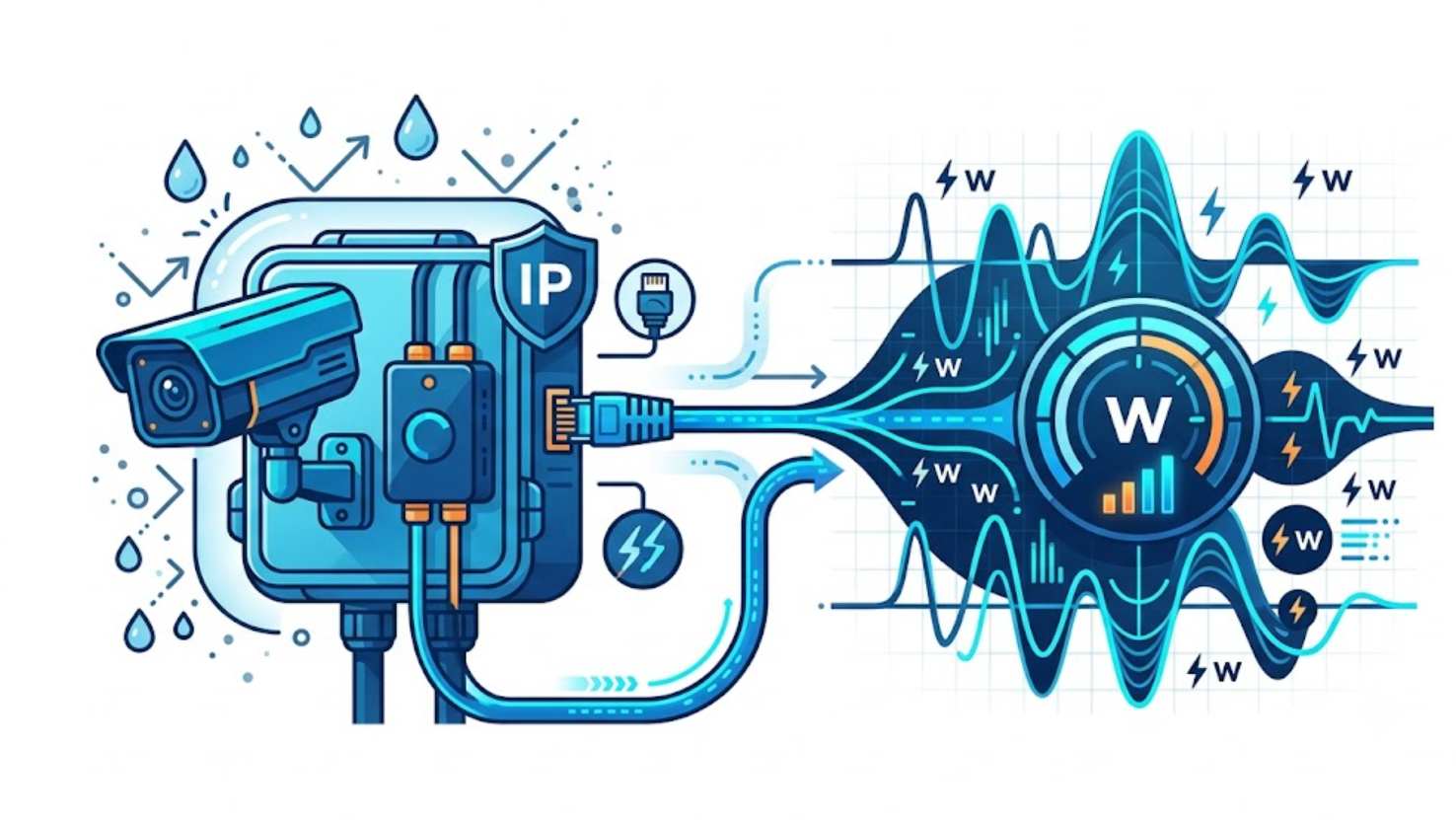
If you have ever shopped for an outdoor security camera, a network-powered speaker, an industrial LED floodlight, or a waterproof audio amplifier, you have almost certainly come across the term wattip — usually written as a combined specification like “5 Watt IP65” or “40 Watt IP67.” At first glance, it looks like a single mysterious rating. In reality, WattIP is a practical shorthand that packs two of the most important pieces of information about any modern electrical device into one label: how much electrical power the device consumes or delivers (measured in watts), and how well its enclosure resists the intrusion of dust and water (its IP, or Ingress Protection, rating).
Understanding wattip specifications is essential whether you are a homeowner mounting outdoor cameras under the eaves, a facility manager rolling out a Power-over-Ethernet paging system across a warehouse, a systems integrator designing a large PoE audio network, or an engineer sourcing amplifiers for a harsh industrial site. Get the wattip wrong, and you end up with a device that either dies the first time a monsoon rolls through, or one that starves for power and never delivers the volume, brightness, or performance you paid for.
This guide breaks down everything you need to know about wattip in a clear, non-technical way — what the term means, how to read the numbers, where you will see it applied in the real world (from PoE amplifiers to IP paging horns), and how to choose the right rating for your specific application.
What Does WattIP Actually Mean?
The word “wattip” is not a formal engineering term in the way that “IP65” or “IEEE 802.3af” is. It is a portmanteau that installers, product designers, and buyers use informally to talk about two ratings that almost always appear together on modern connected hardware. When someone asks about the “wattip” of a device, they are usually asking two questions at once: How much power does it need or deliver? and How tough is its enclosure?
To make sense of wattip, you have to understand each half of the term on its own before you look at how they combine on a datasheet.
Understanding the “Watt” Component
A watt is the standard international (SI) unit of electrical power. In everyday terms, wattage tells you how much energy a device uses per second, or in the case of a source or amplifier, how much energy it can supply per second. The relationship between watts, volts, and amps is straightforward:
Watts = Volts × Amps
A 40-watt IP audio amplifier, for example, is capable of driving loudspeakers with up to 40 watts of continuous audio power. A 5-watt IP paging horn tells you the horn itself is designed to be driven with roughly 5 watts of input power. A 30-watt PoE-powered outdoor light draws 30 watts through its Ethernet cable to produce illumination. In each case, the watt figure is your single best clue about how loud, how bright, or how powerful the device will be in practice.
Understanding the “IP” Component
The IP in wattip stands for Ingress Protection, defined by the international standard IEC 60529. It has nothing to do with Internet Protocol, even though many wattip-rated devices happen to be IP-networked. An IP rating is a two-digit code (sometimes with an added letter) that tells you exactly how well the enclosure of a device resists two specific threats: solid particles like dust, and liquids like rain, jets of water, or full submersion.
An IP65-rated horn, for example, is fully dust-tight and can withstand low-pressure water jets from any direction. An IP67-rated camera can be temporarily submerged in up to one meter of water. IP68 devices can be continuously submerged at depths specified by the manufacturer. The higher the number, the tougher the enclosure — but higher is not always better, because higher-rated enclosures also cost more, weigh more, and can trap heat.
Put the two halves together, and you get wattip: a compact specification that tells you what a device can do electrically and where you can safely install it physically.
The Anatomy of an IP Rating Code
Because the IP number is half of every wattip specification, you need to be able to read it fluently. Every IP code follows the same format: the letters “IP” followed by two digits. First digit describes protection against solids.; the second digit describes protection against liquids.
The First Digit: Solid Particle Protection
The first digit ranges from 0 to 6:
- 0 — No protection against solid objects.
- 1 — Protected against objects larger than 50 mm (like a hand).
- 2 — Protected against objects larger than 12.5 mm (like a finger).
- 3 — Protected against objects larger than 2.5 mm (tools, thick wires).
- 4 — Protected against objects larger than 1 mm (most wires, small screws).
- 5 — Dust-protected. Some dust may enter, but not enough to interfere with operation.
- 6 — Dust-tight. No dust ingress at all.
For any wattip device installed outdoors, in a workshop, on a factory floor, or anywhere near construction activity, you generally want a first digit of at least 5, and preferably 6.
The Second Digit: Liquid Ingress Protection
The second digit ranges from 0 to 9:
- 0 — No protection against liquids.
- 1 — Protected against vertically falling drops of water.
- 2 — Protected against drops falling at up to 15° from vertical.
- 3 — Protected against sprays up to 60° from vertical.
- 4 — Protected against splashes from any direction.
- 5 — Protected against low-pressure water jets from any direction.
- 6 — Protected against powerful water jets (like heavy seas or fire-hose spray).
- 7 — Can be temporarily immersed in water up to 1 meter deep.
- 8 — Can be continuously submerged deeper than 1 meter, as specified by the manufacturer.
- 9 / 9K — Protected against high-pressure, high-temperature jet cleaning.
Common IP Ratings You Will See in WattIP Products
Rather than memorize every combination, focus on the four ratings that dominate real-world wattip specifications:
- IP54 — Suitable for indoor use in dusty environments and occasional splashes. Common on entry-level indoor PoE devices.
- IP65 — The workhorse rating for outdoor devices. Dust-tight and rain-proof. You will see IP65 on most outdoor cameras, paging horns, and LED floodlights.
- IP66 — Same dust protection as IP65, but tougher against powerful water jets. Preferred for coastal installations, ship decks, and washdown zones.
- IP67 — Dust-tight and briefly submersible. Chosen when a device might be temporarily flooded, dunked, or hit by extreme storms.
- IP68 — The highest common rating. Reserved for underwater sensors, mining equipment, and specialist gear.
Wattage in Depth: Why the Power Rating Matters
Once you understand the IP half of wattip, the watt figure becomes the second lens through which you evaluate a product. Wattage is not just an abstract number on a spec sheet — it directly determines how the device performs, how much it costs to run, and what cables and power supplies it needs.
Watts, Volts, and Amps Working Together
Electrical power is a product of voltage (the “push” behind the current) and amperage (the volume of current flowing). A device rated at 24 volts and drawing 2 amps consumes 48 watts. Understanding this relationship helps when you are sizing power supplies, choosing cable gauges, or working out whether a single PoE injector can drive a whole network of wattip-rated devices.
If you overload a power source — for instance, trying to run a 60-watt IP amplifier off a 30-watt injector — the device may fail to boot, may reboot randomly under load, or may work at reduced performance without ever telling you why. Matching the wattage of the source to the total wattage of the loads (with a healthy safety margin, typically 20–30%) is fundamental to reliable installation.
Why Wattage Governs Real-World Performance
For different classes of wattip devices, the watt figure translates directly into a user-visible feature:
- On audio amplifiers and paging horns, higher wattage means louder maximum output and better coverage of large areas.
- On LED floodlights and area lights, higher wattage generally means more lumens (though efficiency varies).
- On heaters, motors, and industrial actuators, higher wattage means more heat produced or more mechanical force delivered.
- On PoE-powered devices, wattage tells you what class of injector or switch you need to drive them.
WattIP in Power-over-Ethernet (PoE) Systems
One of the most common places you will see the wattip concept applied is in Power-over-Ethernet networks. PoE is a technology that lets a single Ethernet cable deliver both data and electrical power to a connected device, eliminating the need for separate power supplies at each endpoint. This is what allows a wall-mounted IP camera, a ceiling-mounted access point, or an outdoor paging horn to run from just one cable.
How PoE Delivers Wattage Over a Network Cable
PoE uses spare pairs (or all four pairs, in higher-power modes) inside a standard Cat5e or Cat6 Ethernet cable to carry DC voltage. A PoE switch or midspan injector negotiates with the connected device to determine how much power it needs, then supplies that power alongside normal network data. The device on the other end — camera, phone, horn, amplifier, sensor — pulls its full operating wattage from the same cable it uses to talk to the network.
The PoE Wattage Standards You Need to Know
Different generations of PoE support different maximum wattages. When you shop for a wattip PoE product, you will see it categorized by one of these standards:
- IEEE 802.3af (PoE) — Up to 15.4 W supplied per port, with about 12.95 W actually available at the device.
- IEEE 802.3at (PoE+) — Up to 30 W supplied per port, with about 25.5 W usable at the device.
- IEEE 802.3bt Type 3 (PoE++/4PPoE) — Up to 60 W supplied per port, with about 51 W usable.
- IEEE 802.3bt Type 4 (Higher-power PoE) — Up to 90–100 W supplied per port, with roughly 71 W usable.
A 5 Watt IP paging horn, for example, will happily run off a basic 802.3af switch. A 40 Watt IP audio amplifier requires a proper 802.3bt Type 3 source. A 125 Watt IP amplifier is beyond even the highest PoE class and needs a dedicated local power supply — a common surprise for buyers who assume every “IP” audio product is PoE-powered.
Common PoE-Powered WattIP Devices
Real-world PoE deployments frequently include:
- IP cameras rated between 4 W and 30 W.
- IP paging horns and speakers rated between 5 W and 30 W.
- Wireless access points rated between 15 W and 60 W.
- IP intercoms and door stations rated between 5 W and 15 W.
- Outdoor lighting and heaters rated between 30 W and 90 W.
Matching each device’s wattage to your switch or injector’s PoE budget is the single most important step in designing a reliable PoE installation.
WattIP in IP Audio and Paging Systems
IP audio is another area where the wattip concept dominates product specifications. Because paging horns, amplifiers, and loudspeakers are often installed outdoors, in stairwells, on factory floors, or along building perimeters, they must be rated for both their electrical power (watts) and their environmental protection (IP).
5-Watt IP Paging Horns
A 5 Watt IP horn is a compact PoE-powered loudspeaker typically rated IP65 or IP66. It is designed for perimeter announcements, small outdoor courtyards, retail entrances, and warehouse aisles. Because it only draws 5 W, dozens of these horns can be daisy-chained across a single PoE switch, making them the go-to choice for building-wide paging.
40-Watt IP Audio Amplifiers
A 40 Watt IP amplifier is a network-connected audio amplifier used to drive passive loudspeakers in medium-sized zones — think a shop floor, restaurant patio, or school hallway. It is usually IP54 or IP65 rated and is powered either by high-power PoE (802.3bt) or by a local DC supply. Because it can drive several passive speakers per amplifier, it is often more economical than deploying many small PoE horns.
125-Watt IP Amplifiers
At the top end, a 125 Watt IP amplifier is designed for large indoor and outdoor zones: stadium concourses, warehouses, parking structures, and public transit stations. Its enclosure is typically IP65 or IP66, and its power requirements are almost always beyond what PoE can supply, so it uses a dedicated mains-connected power supply. In these installations, the “IP” side of wattip refers to network IP (for control and streaming) as well as the Ingress Protection of the enclosure — a rare but important dual usage.
Choosing the Right WattIP Rating for Your Application
The right wattip specification for a project is a balance between environmental toughness, electrical performance, budget, and installation practicality. Here is how professionals approach the decision.
Indoor Applications
For indoor devices in clean, climate-controlled spaces — offices, classrooms, hotel corridors — an IP rating of IP30 to IP54 is usually enough. The watt figure is chosen based purely on the acoustic, thermal, or visual coverage you need. You rarely pay a premium for a higher IP number if the device will never see rain or dust.
Outdoor and Semi-Outdoor Applications
For eaves, entrances, canopies, and covered outdoor spaces, IP65 is the industry sweet spot. It handles heavy rain, occasional hosing, and most dust conditions without significantly inflating cost. On the wattage side, choose based on the coverage area — a small paging horn may need only 5 W, while a large courtyard may demand a 30 W or 40 W device.
Harsh Industrial and Coastal Environments
For factories with washdown cleaning, coastal buildings exposed to salt spray, marine vessels, mining sites, and outdoor installations in high-monsoon regions, IP66 or IP67 is the smart choice. Wattage requirements here are often higher because the ambient noise is louder, the areas are larger, and heaters or fans may be integrated into the device.
Extreme and Submerged Environments
IP68 and IP69K enclosures are reserved for genuinely brutal use cases — underwater sensors, food-processing washdown zones, and equipment that may be pressure-cleaned daily. These are specialist wattip products, and their electrical ratings are chosen with equally specialist cabling and power delivery in mind.
Real-World Use Cases for WattIP-Rated Equipment
To make the wattip concept concrete, consider how these ratings show up in day-to-day deployments across industries.
Security and Surveillance
Modern PoE cameras are a textbook wattip product. A typical outdoor camera might be rated 12 W IP67 — meaning it draws 12 watts of power over its Ethernet cable and can survive dust, rain, and brief submersion. Buyers who focus only on megapixels and ignore wattip often end up with cameras that fail during the first heavy rain or overheat because their PoE switch cannot supply the required wattage.
Public Address and Emergency Notification
Airports, campuses, transit hubs, and industrial complexes rely on IP audio systems where every horn, speaker, and amplifier carries a wattip label. Emergency codes in many jurisdictions require the enclosures to meet at least IP65, and the wattage must be chosen to guarantee audible coverage under worst-case ambient noise.
Smart Building Automation
Thermostats, occupancy sensors, network gateways, and access-control readers deployed throughout modern smart buildings are increasingly PoE-powered wattip devices. Their low wattage (often under 15 W) keeps operating costs down, and their IP ratings (typically IP54 to IP65 depending on location) determine where they can be safely installed.
Outdoor Lighting
PoE-powered LED lighting is a growing category. A 30 W IP66 pathway light or a 60 W IP65 wall pack fits neatly under high-power PoE budgets and can be centrally managed like any other network device. The wattip rating is a single-line summary of both its brightness class and its weather resistance.
How to Read and Verify WattIP Specifications
Getting the wattip right on paper is only half the battle. You also have to verify that the manufacturer’s claims are trustworthy.
Reading the Datasheet Carefully
Look for a clearly stated wattage figure (with a note on whether it is nominal, peak, or PoE-negotiated) and a fully-formed IP code (both digits present, tested to IEC 60529). Vague marketing terms like “weatherproof,” “outdoor-ready,” or “rugged” are not substitutes for a real IP rating. If a vendor cannot cite an IP number, assume the device has not been tested to any standard.
Verifying Third-Party Certifications
Reputable wattip products carry certifications from independent bodies such as UL, TÜV, CE, FCC, or Intertek. These marks indicate that the product has been tested against the claimed standards — including the IP rating, PoE compliance, and electrical safety — by someone other than the vendor.
Watching for Regional and Environmental Caveats
Some products maintain their IP rating only within a certain temperature range, or only when specific gaskets and cable glands are installed correctly. Always read the fine print and follow the installation guide, because a poorly sealed IP67 device is effectively only IP20.
Common Mistakes to Avoid When Selecting WattIP Equipment
Even experienced buyers stumble on wattip specifications. The most common errors include:
- Under-budgeting PoE wattage. Assuming a 30-port switch with a 300 W budget can happily run 30 × 15 W devices is a recipe for a system that boots partially and then falls over.
- Chasing the highest IP number. IP68 costs more, traps more heat, and often is not needed for a device installed under an eave.
- Confusing “IP” for Internet Protocol only. A device labeled “IP amplifier” may not be weatherproof at all — the “IP” refers to the network, not the enclosure. Always check for a separate Ingress Protection rating.
- Ignoring cable and power-supply losses. Long cable runs and cheap power supplies eat wattage. Size your source to the actual delivered wattage, not the theoretical maximum.
- Skipping proper sealing during install. Failing to torque a cable gland, misplacing a gasket, or drilling extra holes in an enclosure voids the IP rating instantly.
Emerging Trends in WattIP Technology
The wattip landscape is evolving quickly, driven by three big trends.
Higher-power PoE. The 802.3bt standard has raised the ceiling for PoE-delivered wattage from about 25 W to more than 70 W of usable power per port. This makes it feasible to run 40 W and even 60 W IP audio amplifiers, large PTZ cameras, and PoE-powered LED lighting without a local supply.
Tighter environmental sealing. As more electronics move outdoors — smart-city sensors, EV chargers, edge-compute nodes — manufacturers are pushing IP66, IP67, and IP69K ratings even for devices that used to live indoors. Expect wattip specifications with higher second digits to become the norm on outdoor gear.
Energy efficiency labeling. Regulatory pressure is nudging manufacturers to publish more transparent wattage information: standby wattage, active wattage, and peak wattage. Buyers of wattip products can now compare devices not just on peak output but on total lifetime energy consumption.
Frequently Asked Questions About WattIP
Is “wattip” an official standard? No. It is an informal shorthand used across the industry to describe products where wattage and Ingress Protection are both important. The underlying standards are separate — watts are governed by SI units and IEC electrical standards, while IP codes are governed by IEC 60529.
Can I trust any product that advertises a wattip rating? Only if the manufacturer clearly cites the wattage figure, the full two-digit IP code, and the standards those numbers were tested against. Look for third-party certification marks to confirm.
Does a higher IP rating mean better quality? Not necessarily. IP measures sealing, not build quality, component grade, or reliability. A well-built IP65 device from a reputable brand will almost always outperform a cheap IP68 unit with poor internal electronics.
Do all PoE devices have a wattip specification? Effectively yes, because every PoE device has a defined wattage (its PoE class) and every PoE device has some kind of enclosure with a stated or implied IP rating. Indoor-only devices may only list IP20, but the specification still exists.
Can I use a higher-wattage PoE switch with a lower-wattage device? Yes. PoE negotiates the actual power delivered based on the device’s requirements, so plugging a 5 W horn into a 60 W port is completely safe. The reverse — a high-wattage device on a low-wattage source — is what causes problems.
Final Thoughts
Wattip is one of those quietly important concepts that separates well-designed installations from ones that fail in the first storm or the first PoE overload. Once you learn to read the wattage and IP halves of the spec together, you gain a practical, at-a-glance sense of what a device can do and where it can go. Whether you are planning a small home camera network, specifying a warehouse paging system, or engineering a city-wide smart-lighting rollout, treating wattip as a first-class specification — rather than an afterthought — is the mark of a professional, future-proof project.
The best approach is always the same: define your environment first (which sets your minimum IP rating), then define your performance target (which sets your minimum wattage), then pick the product that comfortably exceeds both without overspending on capabilities you will not use. Get the wattip right, and the rest of the installation almost falls into place on its own.